I was browsing through the Sailor Moon tag on Tumblr and I just happened to come across this confession:
prettysenshiconfessions: I thought Kaitou Ace was awful and creepy, a borderline villain. Why do so many people want him together with Minako?! [Link]
Ace Kaitou was very sinister, creepy and disturbing... and that’s what makes him interesting. Unlike the Shitennou in Sailor Moon, who had their duty and memories warped and removed, Danburite was fully aware of his actions from beginning to end and seemed to genuinely relish in having the “last laugh” over Minako, and by extension Venus. That is what makes him such an fascinating character. I agree I don’t understand people who genuinely wish he and Minako were a couple, but I can understand why the relationship is interesting because the source of Danburite’s discontent towards Minako is the bitterness he feels about his previous life, Adonis’s unrequited love for his Princess Venus and that all his life she never looked at him twice. Or even once.
On the one hand you do feel sorry for Adonis because he always admired and dreamed about being noticed by Venus but she always put her duty as a senshi first. Perhaps he could have lived with that if that meant she would not give her love to someone else. He felt sad about it, sure, but at least no one else would have her.
All he wanted to do was be as close to her as possible.
Then, while serving in Endymion’s army, just to stay close to his princess, he happened to notice a telling exchange between Venus and his Terran commanding officer. That was when he made another bitter realization.
In a weird way, I think it a cruel irony that out of all the players in this story it was the lowly foot solider who was reborn with his memories in tact. Minako, whoever Kunzite was before Beryl got to him, the other Senshi and Shitennou, even Luna doesn’t remember everything - all of them are in the dark. In this life he is the one who is one step ahead, who holds all the secrets, and yet he uses it to commit crimes and stand against Venus.
Danburite puts a lot of emphasis on paths. He sees Adonis’s path as one of endless struggle, reaching out to Venus yet never reaching her. That he chose in this life to hurt her shows an underlining bitterness that appears to have two roots: the one he blatantly stated - that her duty to Serenity made her unattainable - and then we have the one only hinted at through the panels but its inclusion at all makes it an important factor in Danburite's choice to become a villain: Venus's heart belonged to another man.
It is the latter which was, in my opinion, the straw that broke the camel’s back for Danburite. Takeuchi depicts the “other man” twice within a few panels. First, with Adonis standing directly behind him (OT: Oh hai, Jadeite!) and second, of him and Venus together. This is presumably from Adonis’s POV as they are being viewed from behind, accompanied by a sorrowful expression from Adonis at what is clearly supposed to be a tender moment between Venus and Kunzite. The inclusion of the tiny circling stars between their eye lines with Adonis's own swirling off into nothing, indicating that he is not only watching them but that while their eyes are for each other, his have no inter-locker. Adonis is alone. This moment is so clearly burned into Danburite’s mind that he has to flippantly wave it away by accusing Minako of “always falling in love back then too”, showing that the pain (or resentment) Adonis felt in that second was still vividly felt by Danburite. Had this really been another one of Minako/Venus's one-minute crushes, it would not have been included in his memory. Recalling it proves that whatever passed between Venus and Kunzite was mutual.
There is no point in sugar coating it. It is blatantly implied in this moment that one of Danburite’s key motivations for growing to spite and work against Sailor Venus was this moment. It boiled down to one key emotion:
Jealousy.
The fact that he serves the Shitennou in this life too is another cruel irony. Aside from working for the force that will “rule the world” and is working against everything Sailor Venus stood against, it goes further than that. Presumably Danburite knows how the love story between his Princess and his Commander ended - in tragedy - and being in the know while reporting to the shadow-of-his-former-self Kunzite perhaps gave him some perverse satisfaction. For one thing he had the upper-hand over the man who the “hands of fate” had favoured, the man Venus had loved. Kunzite is still his commander, yes, but Danburite is more aware of the situation than he is. The former has the power but the latter is holding all the cards.
Another thing to remember is that Danburite is also holding the cards tightly to his chest. In doing that, he is denying Kunzite his freedom and Minako the full story. Just like he never could reach Venus, Minako will never again be able to reach out to her (presumed) soul mate. Danburite dies taking the knowledge of Venus and Kunzite’s love affair with him, leaving both of them forever in the dark.
Danburite is perhaps a better villain because he is so aware. Kunzite, the other shitennou and even Beryl are ultimately pawns in someone else’s game. Upon realising the truth of who he was, Kunzite was consumed with guilt and sorrow. Ultimately, he had to have all autonomy taken from him to keep him under Beryl’s thumb. Even transformed into a crystal, he rose up and told Mamoru what he needed to do to defeat Queen Metalia. Ultimately we are shown that Kunzite is a “true knight” - always looking for the light even when surrounded in darkness. Danburite knows what he is doing from beginning to end and even with the opportunity to finally get his Venus, the darkness consumes him.
That is what makes Danburite/Ace good villain. He is complex like Kunzite but is also bad for the sake of being bad, which I admit I like. In the second life he is give the chance to finally win the love of Venus, but he opts instead to use her nativity and habit of giving love out as a weapon to hurt her. It is an act of a man who wants nothing more than revenge. Idealistic Adonis died chasing an unobtainable woman. Danburite died spiting the unobtainable woman by breaking her heart and cursing her love life.
You are left wondering at the end - was it his obsession with Venus that drove him to his nefarious deeds or deep down was he always ultimately a creepy, nasty piece of work? I know what I think - but what about you, um?
So, I originally posted a lot of this on my Tumblr but as with everything else I wanted to shift it over to this place and actually make use of this silly little nook of the internet.
Anyway, the thing that sprouted off this long post I made was an Anonymous message in my inbox:
After I posted a vintage Hermione GIF using the cool new feature Tumblr has that allows you to summon any number of GIF to illustrate your response (Making the thing that Tumblr is best known for ten times easier), I actually put down my own thoughts.
The bottom line is this: anyone who has such an immature reaction to another person’s opinion should be ashamed of themselves. Very often these reactions are born of very small minded and closed off individuals who invest far too much on their feelings into fandom and this is especially potent when it comes to shipping.
I wouldn’t give such a pointless individual the time of day if they came a-knocking on my blog and would only ever post their message to the viewing public in order for my followers to laugh at how idiotic it is.
The rest of this point is an in-depth rant, so feel free to leave now.
(What lies below is basically my opinions on the comments made towards those who worked on SMC, the misunderstandings about what SMC supposedly did to warrant these comments and an in-depth look at Rei/Sailor Mars and the issues some people take with her relationship with Jadeite. If that interests you, feel free to read.)
What makes the whole “Senshi and Shitennou” bashing worse is that a lot of it is built on what appears to be a misunderstanding of the source material. I see the terms “queer erasure” and “hetronormancy” or whatever made-up word it is thrown in to make it sound intelligent. Not only are these words just buzz words to try and make like-minded people get all fired up over nothing but are to begin with. As Sailor Moon Crystal is based more closely on the manga, the writers chose to expand - ever so briefly - on the story thread that Naoko Takeuchi did slip into the manga for at least two of the pairings (Venus/Kunzite and Mars/Jadeite) and stated wanting to explore the relationships one day in her artbook.
The “anger” comes from these small number of people who seem to be under the misapprehension that Kunzite and Zoisite’s was conceived as a romantic one (when it has only ever really been portrayed as such in the 90′s anime), and that the Sailor Senshi are going against character by falling in love with men especially Rei. These two arguments have always boggled my mind because the the K/Z one is a non-issue (Zoisite is described as being “the baby of the family [of the Shitennou and] like a younger brother to Kunzite” in the Materials Collection, not a romantic relationship) and the Rei one is nonsensical. It has always irritated me when people claim that the Senshi being in love with the Shitennou weakens them as characters or is OC, as if women loving men is a flaw in their character. But here’s the thing guys: falling in love isn’t something you choose to do, it just happens.
I know a lot of people take issue with Rei falling in love with Jadeite as a break in character, as she voices several times that she distrusts men and has no desire for marriage. However these are characteristics of Rei not the Sailor Mars who loved Jadeite. Rei’s feelings are likely as a result of watching her parents’ marriage and her resentment towards her father for his treatment of her mother when she was dying. Her attitudes towards marriage can be likened in a sense to Elizabeth I. Elizabeth’s mother Anne Boleyn was executed on false charges of adultery when she was 2-years-old and bore witness to her father’s various troubled marriages thereafter. Elizabeth was lorded as the child “most like her father Henry VIII” and she lorded it proudly in public because it was necessary. In private, she never stop loving her mother nor likely forget what her father did to her: her devotion lives forever in a secret locket on her coronation ring, which contains a portrait of Anne. Elizabeth never seemed to be able to bring herself to marry - and who could blame her after witnesses nothing but disaster and pain come from marriage. Rei’s exposure to crappy relationships are minimal - just her father and his Jadeite-look-alike secretary who she appears to have had feelings for - but the point is that just like Elizabeth I, Rei likely has decided that marriage is not for her. Yet that still didn’t stop Elizabeth I from falling in love with Robert Dudley. There are many reasons why Elizabeth couldn’t marry Dudley (”I shall have one mistress here and no master! No man will rule over me!” being one, the necessity for foreign alliances another) but a lot of it likely stemmed from a genuine fear of marriage itself.
What’s the point of all this?
Well, who’s to say that Sailor Mars did anything other than fall in love with Jadeite? After all, he appears to have been bound by the same vows she was - to put his Master above all else - and likely would not have had marriage on the plate either. But they still could have fallen in love. You can’t help who you fall in love with. You can choose to kiss them, sleep with them, marry them – but you can choose whether or not you love them. That just happens as a result of getting to know someone. Mars could have done just that: she got to know Jadeite and fell in love with him. She needn’t have done anything else; she just loved him.
I admit I do take issue with people who claim that that character like Rei who is supposedly “empowered by not needing a man” falling in love somehow weakens her. Rei is not “empowered” by the fact that she does not need a man - that is just a choice she has made and has nothing to do with empowerment. If we followed the logic that Rei is strong because she doesn’t need a man, then surely we must conclude that Makoto is weaker because she does want to find a man and get married. But they are both equality complex characters who are stronger from their life experiences. That is what makes them worth while characters.
Anyone who takes issue with Rei being in a relationship with anyone including Jadeite, that’s fine, but to call it “hetro-normacy” or whatever the buzz word of the hour is, is a bit of a stretch especially since canonically all Jadeite did was express an attraction for Rei that he didn’t understand. As for Rei did was regain her memories and remember her feelings for Jadeite, which are implied to have been love.
To dislike a ship is perfectly fine but to then be needlessly bigoted or even threaten people who like it is completely reprehensible. Let’s not kid ourselves, we are all here in fandom because we take this stuff way too seriously, but I will afford no time or respect to single person who goes that far with their behaviour. People like that in all walks of life need to be condemned for their poor behaviour.
That goes for all fans who can’t be decent human beings regards of which characters you like or who you ship.
Inherently, this whole incident shows how people on the internet do seem to take the relationships of fictional characters serious, perhaps more so than the relationships they have in real life. I used to put a lot of value into them myself but I have since grown up and got older. While it is debatable whether I got any wiser from my experiences as a "shipper" of the die hard variety but I know for certain it is a world I do not want to return to.
I have just spent the best part of my afternoon and evening trying to fix the MESS that Windows 10 made of my laptop after I allowed it to update from my Windows 7. I was apprehensive, of course, but I figured it would be better to upgrade and “embrace the future”.
Well, in my opinion Microsoft need to get back to the drawing board.
Now before you say anything, no it has nothing to do with the interface. I actually don’t have a problem with the panels or dashboard. I also admit that the computer booted up a lot faster than Windows 7 does. (But don’t put it to Sleep/Hibernate, have lunch and then come back because it will be going painfully slow).
But that is where the positives end. After less than 48 hours with Windows 10, I knew I had made a mistake as I undercovered a load of glitches and errors. Let me count the ways:
1. None of my existing files would play in the newer versions of the Windows tools. Most noticeably my videos in Windows Media Player. It was like I had gone back in time with WMP 11. Do you guys remember the original “Windows RG” flash game?
Also an 1b.) Programs that had nothing to do with Microsoft suddenly stopped working when they had been perfectly capable before. Manga Studio for example stopped recognising PS files. Odd considering that it has the ability of saving files as PS files! It was like I had stumbled into that not least because;
2. Error messages galore! If you tried to open a single app on Windows 10, an error message would pop up saying that “Element not found”. This happened for:
+ Internet Edge, Microsoft’s “Not” Explorer browser. Is it as rubbish as Explorer used to be? I don’t know. I never saw the darn thing!
+ The App Store itself. Makes sense seeing as none of the other apps worked.
+ Settings. Yes, the settings. This led to 3:
3. The Setting tab was completely useless and unusable. If you did manage to get a response, the timer would come up before giving you the dreaded “Element not found” warning. This meant I couldn’t update, couldn’t reinstall anything to try and fix the errors and, worst of all, I couldn’t access the tab that allows you to switch back to your old interface!
The issue with the apps is a weirdly reported issue that Microsoft claimed to be working on. My understanding was that they had come up with a fix in the latest update, provided you also ran a downloadable troubleshooter too. However with updates not occurring on the laptop and being unable to prompt them myself, I wasn’t going to give them the benefit of the doubt. Windows 10 had to go.
How did I fix it? I had to load up Safe Mode using the Run command, msconfig. Another archaic feature of Windows 10 is that because most of the buttons don’t work - not just the apps and settings but also links in the troubleshooters and back up - is that you have to rely on the System Run to retrieve EVERYTHING for you. Yes, a feature most of us never used or only used for Task Manager became an essential tool for getting Windows 10 to struggle along.
It also seemed to struggle with remembering my preferences, probably as a result of the settings being broken, as I was asked if I wanted to make Google Chrome my default browser every time I restarted the laptop. Believe me, I reset it a lot trying to make it work.
I have never been happier to be using Windows 7. Using Windows 10 was one of the most frustrating experiences I’ve had in a while. I wanted to cry I was so angry to see my files unusable, nothing working (or working sometimes only to freeze or crash) and not being able to get rid of it without booting up Safe Mode.
Safe Mode is a system people tend to use when there is a serious error on their computer, like catching Malware or a virus. This is what Windows 10 felt like. I checked my specifications - my laptop was perfectly capable of running Windows 10. It just did not install properly and then blocked me out of any means of fixing it quickly.
Windows 10 had serious, game-breaking flaws that need to be addressed urgently. I urge anyone who had a laptop full of memories and isn’t prepared for a Clean Install not to bother upgrading to Windows 10 until Microsoft have fully fixed these issues.
I know now why they’ve been rolling Windows 10 out for free, though. They wanted us to be their beta testers. Windows 10 is free to anyone with a genuine copy of Windows 7 or 8 until (I think) June next year. After that, you will have to pay for it. Presumably by that point, they’ll have fixed most of the issues - or at least one would hope - and goodness knows, no one would pay for Windows 10 in its current form.
More specifically, the Meowth belonging to Team Rocket.
He is in actuality a wild Pokemon. There is never a situation where Jessie or James indicate that he has a Pokeball to return to, should the need arise. There is, of course, that stint in the Unova series where Meowth was travelling with Ash and his friends - actually some of the best episodes I had seen in a while and genuinely made me feel sad when it really was all just a trick, not least because Ash came to genuinely care about Meowth and see him as part of the team - where on several occasions Iris or random NICs (Non-Important Characters) tried to catch Meowth. He would always escape the Pokeball and declare that he would “never be caught!” for anything.
Meowth is actually a very important Pokemon, though. This is not just because of his ability to talk but the insight he gives into Pokemon psyche.
Meowth’s Inability to Learn Pay Day
According to Meowth, his ability to speak negates his ability to learn the signature move of his species, Pay Day. In the episode with the Meowth-worshiping islanders, he tells Jessie and James that when he should have been learning Pay Day he was teaching himself to talk. Initially, the implication of this is that Meowth can’t learn any other moves, like TMs or any of the moves he would naturally learn growing up. This would suggest a connection between a Pokemon’s ability to learn human speech and their ability to grow. If Meowth has stunted himself by learning to speak then this could also have implications for his ability to ever evolve into a Persian.
One argument against this theory is that Meowth tried to/managed to teach himself Night Slash - but refuses to use it because it is too scary. It is never made clear whether he successfully managed it but the fact that he was attempting it, and was able to do it enough to realise it is a scary move, suggests he must have had some degree of success. So, while his speech negated his ability to learn Pay Day it did not affect his ability to learn new attacks altogether.
As a result of the above, this is Meowth’s probable movelist:
- Fury Swipes (His most commonly used move)
- Bite (Which he used in the Sandshrew episode)
- Scratch (First move he ever used and he invariably uses it)
…and the third slot is taken up by his ability to talk.
*It is also possible that one of the three moves above was copied over so Meowth could learn Night Slash.
This indicates that he can learn other moves and presumably could teach himself TM moves. Meowth has a fairly interesting move-pool and, if Jessie and James wanted to have a Pokemon who could use an electric attack, they could steal a TM for Meowth and teach him Thunderbolt. The fact that it has never occurred to them to ask Meowth to learn some of the moves in his arsenal via TMs, which they could easily steal or even ask Giovanni for (If he’s happy to waste money on those robots, surely he’d be pleased at the prospect of making Meowth a useful battler), indicates that Meowth would have to learn these useful TMs as a captured, trained Pokemon - which Meowth would NEVER agree to become. As a result, his experience growth is stunted.
Meowth as an Untamed Pokemon
So, Meowth possibly shows the key differences between a wild Pokemon bonded with humans and a human trained Pokemon. While a wild Pokemon may have its “freedom” it will never be as powerful as a human trained Pokemon. This goes back to that Sparrow in Episode 1. According to the Pokedex, wild Pokemon are often jealous of human trained Pokemon - this could be because the latter is innately stronger.
But Meowth NEVER shows any indication of wanting to be stronger. His desires tend to revolve around being rich and successful, being Giovanni’s “Top Cat” again by any means possible not matter how naughty and bad. We can infer from this desire that Meowth perhaps was popular with the Rocket boss as a result of his unique speaking skills but he likely fell out of favour due to that being his only positive quality - and that he cannot learn Pay Day. In Island of the Giant Pokemon, Meowth is shocked when Koffing and Ekans tells him that Pokemon only do bad things because the humans around them are bad. Meowth exclaims, “But my Master isn’t here and I always do ad things!” - but if we were to assume that his true Master is Giovanni… well, that would probably explain by Meowth “always acts bad”. Together with the humans having most influence on him being Jessie and James, or other Rocket members, it is the only behaviour he knows. Prior to his association with Team Rocket he also worked under the influence of a Persian who ordered the little Meowth to commit petty crimes so they could survive. Then before to that, he was an abandoned baby Pokemon who was always starving and treated cruelly by humans who saw him as a pest. Ultimately, Meowth is the product of a very harsh upbringing.
Considering the level of nastiness humans and even members of his own species showed him before be met Jessie and James, it is also no surprise that he stays with them. Despite being members of the notoriously cruel and merciless Team Rocket, Jessie and James are very kind to their Pokemon. They can be harsher to Meowth but probably because they treat him like they do each other and do not consider him to be an ordinary Pokemon. They interact with him like they do each other, treat him like an equal. Given the life Meowth led for most of his babyhood it is understandable that his goals would match that of Jessie and James, and it is worth noting that none of them ever realistically selling out the others for all the glory. Meowth, in fact, is the only one who ever came close. In the Meowth worshiping cult episode, he briefly considered selling out the two Js for what he thought was a better deal. However when his team members return to help Meowth trick a stadium into thinking he can use Pay Day, he realises just how much they care about him and chase after them. A lot of the positive lessons that Meowth learns about comradery tend to come from Jessie and James. The rest come from Pikachu.
Meowth as Proof of Pokemon Sentience
“Pokemon is bad because Master is Bad,” is what Ekans told Meowth, a fact that shocked him. This lesson is likewise echoed by Ash when Gary stated that the mysterious Pokemon he battled - later revealed to be Mewtwo - was evil. These statements infer that as far as humans are concerned, Pokemon are innately good and only do bad things because the humans who train them (or they just interact with) are bad.
I already explained how I feel Meowth came to be “bad” is the result of a bad upbringing. Yet one of the big differences between him and, say, his biggest rival Giovanni’s Persian is that Persian is a trained Pokemon obeying the orders of his trainer; Meowth does bad things off his own back.
But the key thing is the difference between being bad and being evil - and Meowth has never done anything to suggest he is evil. He is a naughty, sneaky and badly behaved Pokemon, which if we are honest is not anything new to the Pokemon world nor is it a trait unique to him. After all, Ash’s own Squirtle was a gang leader who committed petty crimes for giggles before he joined the team. Hell, Scrafty are hoodlums and will do “naughty” things to survive. Meowth as a species are pretty much the Scrafty of their generation, associated with being criminal tricksters. So, if we look at our Meowth we might just be seeing a personality trait of a whole species being taken to a new level thanks to his ability to voice his intentions/feelings in a language that idiotic humans can understand.
Meowth is so good at speaking that it is easy to forget sometimes that he is a Pokemon who taught himself how to do that little trick. That he taught himself suggests that any Pokemon within reason could also teach themselves to speak, if they wanted. So why don’t they? Well, we can see from Meowth that it appears to have at least in someway hindered his development. He isn’t a strong battler and seems to find it difficult to learn new attacks. Many Pokedex entries suggest that battling is an important part of a Pokemon’s culture, not just something necessarily forced on them by humans. Perhaps most Pokemon don’t realise they could learn to talk or maybe they do know but opt not to because the chance to learn more attacks is more important to them.
Either way, that Meowth can express himself gives us such an interesting look into the way a Pokemon’s brain works. It proves that most Pokemon are almost certainly on the same level of intellect as most humans. In which case, the final question should be this - how did humans become the dominant species when Pokemon just as intelligent as a Meowth but with far superior powers can be captured and placed in a Pokeball?
I have been doing a lot of personal research into gemstones, crystals and their differing types. It was a hobby of my mother’s when she was alive and I also wanted to research different stones and minerals anyway for a project completely unrelated to Sailor Moon. However I also have been looking into my own fanwork for the fandom, and in doing so it required me to look into the different gemstones that villains in the manga are named after. The most significant that will come to mind of any of them though are the Shitennou (and Beryl).
Below I have made a list of interesting findings about each of the meanings behind the stones. This information comes from several books and sources and put into exclusively my own words/interpretation, so if you wish to verify any of the information it is easily found through getting some Gemstone based books (both scientific and spiritual) as well as cruising the internet.
KUNZITE
Let’s start out with the Leader of the Pack and the one a lot of people like to gush over the most when it comes to analyzing his crystal. His name sake, Kunzite, is the gemstone that comes from a mineral known as spodumene. While the name “kunzite” can be (incorrectly) used to refer to any colour of spodumene it actually refers to the pink spodumene, which is the most common colour of the gemstone varying from deep vibrant pink to almost clear pale.
Other colours spodumene can come in are purple (lilac kunzite) or yellow/green, the latter of which having its own common name, “hiddenite”.
The real-world name “kunzite” was coined in the early 20th century by George Frederick Kunz, for whom the common pink spodumene i.e. true kunzite gem was named after. Kunz himself was a famous mineralogist and mineral collector. His book, The Curious Lore of Precious Stones, is one of the go-to books for gemology even today. Of course, in the SM-universe it is implied that *possibly* the gems were named after the Shitennou, in this case Kunzite’s.
The first thing worth noting is that all forms of spodemene are delicate, rating 6-7 on the hardness scale and being prone to losing colour and lustre in natural daylight. When reflecting on Kunzite’s comment in the manga about Tokyo’s over use of electricity and light pollution he states:
“What offensive, futile light. The true beauty is within the shining darkness.”
The tone is taken to be that of wickedness and evil, as he wishes to “drag” the senshi out to “grovel” before the darkness. However, there can be deeper meaning attached to Kunzite’s words. Considering that the Dark Kingdom Kunzite is a warped reflection of his true self, this line can be taken to reflect his inner philosophy. After all, kunzite are also exceptionally beautiful; vitreous gems, meaning that light passes through them and reflects off them in a similar manner to glass. Yet, as earlier stated, wearing kunzite jewellery means you must be weary of exposing it to light else the stone will go dull. People who own kunzite jewellery consider it as “evening wear”.
By taking these physical properties of the gemstone, the earlier quote from Kunzite takes on additional meaning. The lights of Tokyo are offensive to him because it negates the beauty of darkness. This can be taken to mean both the glory of the Dark Kingdom he serves but also the most basic observation - that Tokyo is polluting the night sky and drowning out the stars. Any keen star watcher will tell you that getting a good look at the night sky in major cities is near impossible due to the orange hue let off by city lights. Even stars as beautiful and large as, say, the Evening and Morning Star.
To the Dark Kingdom Kunzite, he likely sees the unwelcome infiltration of light into a period of time where the world is naturally supposed to be dark and it becomes an attack on him in kind. He is the “Evening Stone” who thrives best as a shining glimmer in the dark. In many ways he and his gemstone are very much the Yin on the Tao symbol: light in the darkness. Going on from this we can add extra meaning to the spiritual properties often associated with kunzite.
In crystal healing, kunzite is considered not only to be the “Evening Stone” but also the “Stone of Balance” due to its properties associated with both the mind and heart: the former is a quirk of spodumene (mind chakra) while the latter is predominant in kunzite, it being considered by all to be a “love stone”. Moreover the presence of kunzite in crystal spells often lends way to balance overall due to think connection of linking the heart with the head. This need not be explained in references to SM’s Kunzite, who as leader would likely be expected to represent a good balance within his group. Nonetheless the strong affinity between the head and heart leave interesting things to interpret about his SilMil personality. Kunzite is so often viewed as a stoic character who lives only in his head yet the gem kunzite alone is predominantly a heart/love gem. From this we could perhaps infer that while Kunzite will often look first to the logical, clearest root to success, he will always seek to choose the moral path and the one most beneficial to those he loves - his men, his Prince and presumably even his assumed lover/mistress, Venus.
The gem kunzite is, unsurprisingly, ruled by the Goddess Venus and associated with the namesake planet. In antiquity people believed that the cosmos was reflected in gemstones and those of pink colour were thought to invoke Love Goddesses. Among the many things kunzite is associated with, it is particularly symbolic of purity, conception/new life, children and, of course, love. While all Venus-ruled gemstones stand for success in romance, kunzite in particular is considered a symbol of “Unconditional Love”. For this reason, kunzite evokes all types of love: romantic, parents/children and personally feeling love. This focus on the emotional soothing power of love makes it a nice little contrast to Venus as well as an object ruled by her. In terms of the Senshi and Shitennou parallels, Kunzite represents “Emotion” while Venus represents “Attraction”.
This likely made for an interesting dynamic between the two back in the SilMil. If we take these aspects of Kunzite’s gemstone to heart, we could perhaps guess that his true self as indeed the Guardian of Purity and Affection as SMC put it. We can imagine that Kunzite was reserved towards Venus’s advances. If Venus truly was like Minako then we can presume she still enjoyed being the one doing all the chasing, which Kunzite would let her do with a small smile and chuckle. His focus would likely have been to keep control of his own feelings but ultimately would give into what the Heart wanted.
JADEITE & NEPHRITE
No matter how you see the relationship between these two brothers in arms in SM, the two minerals Jadeite and Nephrite are twinned souls in the gemology world. You can’t really talk about one without the other so I will consolidate them into one header and hopefully explain why this might be significant.
Jadeite and Nephrite are both forms of Jade. For centuries they were thought to be exactly the same but 1963 the discovery was finally made that there were in fact two types of jade despite the differences being relatively minor. To quote the Phillip’s Guide to Gems, “both are aluminium silicates; both are made out of intertwined crystals that were compressed under high pressure; and they are often found side by side.” (p. 142) The difference between the two really only comes down to what they are made out of and how it affects their textures and lustre.
In the case of jadeite - the more popular of the two - it comes in a wider variety of colours (almost all the colours, in fact) and has more vibrant colour overall in jade. It is heavily linked to realising skills and goals. As a result the stone is often credited with stimulating self-reliance and confidence. However this is not a cocky emotion - in fact jadeite is associated tranquility and calmness.
If we link that to Jadeite himself we can get some vital details about his true personality. He generally works alone, is respectfully confident (right up until his death) and actually does remain remarkably calm in difficult situations. We know all this from what little we see of him in the manga.
However a interesting comparison between jadeite and nephrite is that the latter is a stronger material. It is more popular for detailed cravings (such as miniatures) due to it not chipping easily - something Jadeite can do when not smoothed down. For this reason nephrite has also been used more commonly for weaponry. This sort of plays into Nephrite being the reckless warrior type while Jadeite is the calm and laid back brother.
Both stones are known as “dream stones” and both represent the following: love, courage, justice, wisdom. In Sailor Moon Crystal, the writers decided to give the boys “Elements of Harmony” style titles not unlike the girls’ intros as “Guardian of —” titles. Jadeite’s was the Knight of Endurance and Harmony while Nephrite was Knowledge and Understanding. All of these are qualities associated with jade.
I can’t figure out if there was a specific reason why Naoko Takeuchi chose two forms of jade for two of the Shitennou but I genuinely do think that the fact she did means we can perhaps infer a connection between the boys. Perhaps a “two sides of the same coin” aspect? Well, they are close in age (18 and 19) and while Jadeite dies Nephrite is genuinely upset about it despite him picking on him earlier, making fun of his inability to deal with the Sailor Senshi. This is another aspect I have to admit I like about SMC - it showed the boys subtly coming in to help each other when confronting Beryl and so on.
Jadeite and Nephrite were likely very, very similiar and that is why they were best friends and rivals. They took shots at each other but in the end they would both go down fighting together or for each other because they were brothers in arms. Jadeite was calmer, cheerful and more laid back while Nephrite was serious, confident and perceptive. They complimented each other perfectly.
ZOISITE
The youngest, daintiest and arguably most creative of the Shitennou, Zoisite is named after a mineral in its own right. It has several subcategories aside from: there is basic tumbled Zoisite; Thulite, Ruby Zoisite (Anyolite) and Tanzinite. It is the latter variety that is the most celebrated due to its gorgeous violet-blue colour.
On its own, zoisite is a crystal that best described as a “booster”, “upper” or “stimulant”. It is a stone that supposedly celebrates uniqueness, encouraging the bearer to break the mold and be themselves. Reading all of this, it is hard not to think of the 90′s anime Zoisite who very much did march to the beat of his own drum and relished in his own individualism. He, of course, in virtually a different person compared to the manga, not least in the somewhat admirable genuineness that surrounds Manga!Zoi. Naoko’s Zoisite loves Jadeite and Nephrite, reflecting a sense of brotherhood. Likewise, while he is clearly a little terrified of Kunzite, Zoisite follows his orders without question. The gemstone zoisite is most famous among crystal enthusiasts for invoking “trust in the universe” and “trust in ultimate goodness” in life. It is a stone that brings happiness and quells fears.
Dark Kingdom Zoisite is a trickster who plays dirty, is a cheat and is prone to petulant outbursts of anger - the exact opposite of a Zoisite stone, a stone of ultimate trust. In the 90′s anime it is linked to his vanity. In the manga, it is linked to his pride. For Zoisite to have all of these negative aspects to his personality yet have such an underlying affection for his brothers makes for a interesting mixture as it implies that while Beryl could twist his “true self” into a nasty little brat yet retain his sense of loyalty to the others.
From the properties of zoisite stones, we can perhaps infer what the true Zoisite was like. Dark Kingdom version is a cheat and a manipulator, Elysion Zoisite was then probably honest to a fault, in keeping with his stone. He was likely still proud, very sneaky and trickery - but he would likely play fairer and not resort to dirty tactics. His loyalty to his brothers would be just as fierce and would be the one to always find the bright side.
These are the aspects of the basic zoisite, but what about the other forms? What could they tell us about Zoisite’s character?
Let’s start at the top and look at Thulite. It is named after the mythological region known as Thule, thought to be a region in Scandinavia. Immediately the “European Commander” bells are going off inside your heads, right? I personally think it would be nice is Thule was indeed Zoisite’s Kingdom back in the Silver Millennium.
Thulite is the “nurturing” gem, one that comforts shy, withdrawn and emotionally damaged people, especially survivors of severe abuse. In other words, it is the stone that defends the meek. This makes sense as Zoisite himself is often portrayed as well physically smaller than the other Shitennou and plays in again to the stone being a “booster” of self-worth. Ruby in Zoisite once again enhances creativity but has the added bonus of having an underlying focus, again lending weight to the fan theory that Zoisite is by far the most intelligent Shitennou because he is both creative and goal focused. It negates laziness. Finally, there is the beautiful Tanzinite, a stone that smooths an overactive mind. It slows down a creative mind that has gone into overdrive and helps the bearer calm down.
These three stones really add to the spectrum of what the SilMil Zoisite could have been like: a gentle and nurturing young man with a brilliant, active and creative mind. There was no locked room he couldn’t think his way out of. He believed in being true to himself and encouraged others to be the same - but always tried to do too much. He often forgot that he was only human and had to be reminded to calm down. But his mind was always ticking over. Always.
And it has to be said that of all of them, I feel the Ace Attorney fans are among some of the funniest, nicest and most open fans I have seen in a long time.
Anyone will tell you that shipping is always the many conflict in any fandom. More so than controversial character debates.
This mainly revolves around shipping habits. Due to the sheer amount of characters and next to no canon ships in AA, everyone is a level playing field. There is a lot of slash in the fandom, as in most these days, but its creators are rarely as bigotted or mean-spirited as other slash fans I have encountered in other fandoms.
Truth be told this is probably because an awful lot of them acknowledge that canonically, outside of fandom, their characters of slashing choice are either (at least) bisexual or canonically straight and they are simply playing with the source material as they see it. That is really nice considering that I have seen a huge amount of shippers in general (het as well as slash but most of the fandoms I have ended up in have been DOMINATED by non-canon slash pairings) have used misreading or damn twisting of the canon in order to justify beating down/scoring points with rival pairings.
Don’t get me wrong - every fandom has a bit of asshatery here and there. Ace Attorney does have those one or two people who just can’t help exploding over things that don’t matter… but it feels much more controlled than anything I have ever seen. I have to say that the combination of so many characters and shipping possibilities IS healthier for fans than anything else.
As a predominantly casual shipper who only writes het between non-canon pairings, I have felt so comfortable in this fandom and have felt the freedom to work and express art so much better than any other in a while.
After the success of the Pokemon Black and White Nintendo DS games, the follow-up game is due to hit UK game stores next month. Unlike previous games, which would have simply brought out one 'Bonus' game with added features and a revamped story like, such as Pokemon Platinum in to Diamond and Pearl, Emerald was to Ruby and Sapphire, Crystal was to Gold and Silver, and - who could forget - Pokemon Yellow, which featured the undisputed Pokemon mascot Pikachu, these new games are literal sequels to the original games.
Moreover if the reaction to this trailer is anything to go by, it seems that cute little Pikachu is starting to lose his following and his audience. After watching this promotional trailer for the new Pokemon Black 2 and White 2, my first thought was to find out what others thoughts. I was not surprised to find that many people had viewed this trailer wistfully, wishing that this was an actual anime. 'Is that really what I think it is?' one comment said, 'Pokemon... being cool?'
For me, the story-line behind the games has always been the highlight of the whole thing, and from other have said, these new games are going to carry on the arch of Team Plasma and the struggle between two factions - those loyal to Ghetsis and those loyal to N. It has to be said that the latter has enjoyed a lot of popularity with the gamers as one of the most complex villains/rivals the games have ever seen. Unlike previous Bosses in previous generations, N is more misguided than bad. As a result, he has very much been taken to the heart of the gamers, especially the female players who (and I felt this too when I played) feel strangely drawn to his faye personage.
Needless to say both male and female fans are thrilled to see his return in this new trailer, and this trailer, together with the established story of the first two games and the new ones, many people are starting ask - why can't the actual Pokemon anime be like this?
Speaking for myself, I have not watched the Pokemon anime since I was about eleven years old at the most specifically because it became too childish for me. I know that an awful lot of maturity can be lost between the Japanese and English dubs, as I found out around the same time when I was into Cardcaptors only to discover how much was cut and re-edited from the original Cardcaptor Sakura. I stayed with that fandom until I was around fourteen when I started to lose interest in anime simply because it usually was so dumbed down by the time it got to the western world.
The games on the other hand maintain their storylines throughout and I feel this is what people pine for. The kids, like me, grew out of the anime but you never grow out of playing the games. Moreover, if the prospect for an edgy and universally appealing Pokemon series was produced, whether it was a 13 episode short or a movie, they would watch it.
The feelings I got from the trailer were reflected in the comments of others fans, who felt that while the games have grown up with the audience - i.e. portraying the heroes as being 16+ and seeing them face greater perils - but the rest of the franchise has not. I only found out recently that Pokemon was still being dubbed into English and shown on TV. Moreover, and I get the sense this is what bugs the audience the most, the hero Satoshi (Or "Ash" as the English audience know him) has never grown up either literally (Indeed, he appears to still be ten years old after 14 years of travelling), or as a person. Given that kids shows need only to be repeated with each new generation, keeping him in limbo for that long is, I suppose, silly.
I for my part agree that maybe it is time for him to move over for some new heroes. While I am unsure how successful a B2/W2 anime would be, given that the B/W storyline and characters are so prominent. I get the feeling - and I concurr - there is some disappointment that Touko and Touya don't appear in the game at all, except for one reference.
Either way, this trailer has certainly made me hopeful for the new games.
In April 2012 Penguin Press brought out the first set of what they referred to as Penguin English Library, a selection of fiction books from some of the great English authors of the last three centuries. These included some of the usual suspects of Dracula by Bram Stoker, Jane Eyre by Charlotte Brontë, Frankenstein by Mary Shelley, Moby-Dick by Herman Melville, and Great Expectations, A Tale of Two Cities and Oliver Twist by Charles Dickens. Then there are some titles that the average punter might not have heard of before, such as The Private Memoirs and Confessions of a Justified Sinner by James Hogg and Lady Audley's Secret by Mary Elizabeth Braddon, (both of which are books I will be reviewing here on this blog). With each passing month in the run up to Christmas, Penguin intended to release another ten titles to compliment the original twenty that hit the bookshops that Easter.
I first encountered them in the Foyles at King's Cross St Pancreas station and I bought two immediately - the two I am reviewing this summer. They have a soft feeling cover and a consistent theme to their covers, much like the Black Classics except the form is cheaply made and thus the price is lower even for thick books like Moby-Dick and Little Dorrit, being just £5.99 each. Moreover the selectiveness of the titles means that readers who see all the copies laid out can come across the rarely, lesser known classics like The Monk, Evelina and Two on a Tower.
As all the novels themselves are written in the English language there is no need to analyse the quality of the translations. The novels themselves are as good as their writers are. What the Penguin English Library comes down to are two things: their looks and the selection of titles. Due to the prettiness of the covers, the materials and the fact that every copy comes with the Penguin English Library leaflet means it wins on the first mark. Due to the obscurity of some of the titles, it wins on the second mark too. Had I not discovered these books, I would not have discovered the authors that I have - despite being an English student.
Do check them out. They will introduce you to a lot of 19th century novelists and their titles but they also make a pretty addition to your bookshelf.
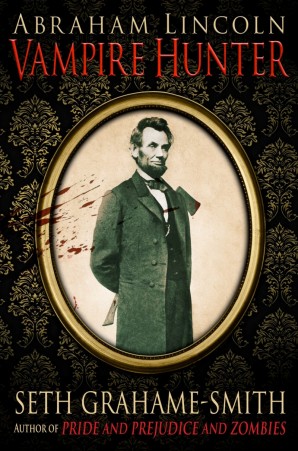
When I first come across this novel as I hunted around the sales tables at Waterstones, the thing that struck me was how ridiculous the notion of the President of the United States during the Civil War, who was assassinated by a die-hard Confederate and actor, John Wilkes Booth, was a sort of Buffy vampire killer. I
knew that it couldn't be a serious piece of work. Indeed, the writer Seth Graham-Smith has also published other odd titles that people who frequent books shops will doubtless recognise: Pride and Prejudice and Zombies. The parody novel of Jane Austen's classic surpassed all expectations and became a surprise bestseller.
Yet if I have one major issue with this novel it is the question of whether I was supposed to take it seriously or as a joke. Considering the author's track record, the first assumption must be that it is a parody. The reason why it is so easy to be thrown one way or the other is because that the manner in which Graham-Smith presents this novel is very subtle. Posing it as an historical analysis of Abraham Lincoln's lost diaries, this is used to present the ridiculous story. Accompanied with mocked up photographs of Lincoln, posing with his "famed" ax with which he slayed the vampires, the book is not only written like a historian but has the feel of one also.
The problem isn't this but the fact that at times the author seems to find it hard to maintain the aura of a historian, and instead falls into the trap of simply talking through AL's diary entries rather than just 'picking out' sections and then summarising them in his own words. Moreover the manner in which the 'writer' comes across the 'lost diaries' is a rather cliche manner of a mysterious man passing them over. While this cover story only takes up about the first 20-pages, it still takes a long time to actually get into the book or become the amusing story that Vanity Fair boasts it to be.
Another issue I had was with the pace - it is often too quick, speeding through Lincoln's life like a runaway train. The depth of research that has gone into the novel is quite remarkable but at times it felt like reading a mixed cocktail of different types of writing: the diary, the historian and the novel writer. While this is not necessarily an issue when the three methods are employed effectively, I can't help but feel that more could have been done with this concept of Lincoln as a Vampire Hunter.
Overall this is undoubtedly a well-researched novel that has put a lot of attention into detail, especially in regards to the American Civil War. While the author's style of writing fails him now and then, this is a very easy novel to read and does not require much thinking about. It by no means keeps you wondering, not because it assumes the writer knows anything about Lincoln but because when the connection between vampires and the slave-owners of the American South is made, it feels too obvious a way to bring the book-sucking creatures into the Civil War environment.
To people who might wish to avoid this novel because it is 'yet another vampire novel', they needn't fear as the vampire aspect at times does not really affect the overall presentations of Lincoln's life. The author finds a fair balance between portraying a human side to "Abe" as well as his eccentric vampire-hunter side, even if he doesn't quite manage to insert vampires comfortably into Lincoln's life.
If I could say one thing about this book, it is that it is too short. I say this not because I enjoyed it so exceptionally that I wished I could read more, but because once I got to the end I felt it should have been longer. There is a lot that the author could have done and failed to do.
People who are familiar with the Roman Empress Livia will likely think first and foremost of Robert Graves's I, Claudius, in which she systematically moves to annihilate all the troublesome members of the Imperial family who stand between her son Tiberius and the succession to her husband Augustus's new dynasty. Matthew Dennison's book attempts to absolve Livia, to prove that she did not murder her stepdaughter's husbands, Marcellus and Agrippa, and children, Gaius, Lucius and Postumus, and all manner of wicked deeds that the character contrives and relishes within the hallowed texts of Graves's classic.
Yet there are two major flaws in this history that let it down completely. First is its cherry-picking of the ancient historical accounts, only accepting the ones that favour Livia and coldly beating down the accounts of those that do not favour her - the most obvious being Tacitus, upon whose accounts that Graves based his Livia. Second, is that while the book is very readable and pleasant to read, it says very little and is based primarily on assumptions rather than facts. Most annoying of all, and this is a problem with many non-fiction books, is that the writer attempts to use pointless sources that bear no resemblance to their topic matter to justify their arguments.
It is true that Dennison is faced with the problem that his subject matter is one that we know very little about. Women were rarely written about unless they were famed for murder or incest (or indeed both), as with the infamous Clodia (who is mentioned several times by Dennison). Trying to get to the bare-knuckled truth about a woman in Rome is an impossible task and, credit to Dennison, he does his best to piece together an impression of what Livia's life would have entailed. However it is his constant attempts to examine Livia's 'psychology' that undermines all this hard work as textually it is assumptions, not facts, that takes up the whole book.
Ultimately, the book would have done better to be much shorter. Most of it feels more like a PhD student's final thesis, using quotations such as Tennyson's poem, 'He chopped down the family tree...' which is the most references of a backlog of irrelevant passages that prelude each chapter. I found myself reading ahead to avoid them as they bore little importance to understanding his arguments about Livia.
As already stated in making his arguments about Livia, he pushes away any negative statements about her and basks in the positive - what little there actually is. While Livia may or may not have poisoned half her second husband's relatives, his arguments are once again let down by the fact that he only cherry-picks with Livia and not with the other imperial women, such as Octavia and Julia. He repeatedly remarks upon Octavia's blind hatred of mothers, 'especially Livia', and his presumed jealousy of her, despite it having no point in his argument past the death of Marcellus. Probably more unfair is his judgement on Julia: at one point he questions the absurd statement that she prostituted herself in the Roman forum (considering her renown for being fairly haughty), but later states the account by Seneca as if it were fact.
The overall narrative is jumbled, darting back and forth in time only to repeat itself. I was especially disappointed by how little time he spent on the later years of her life, in which Livia was emboiled in several scandals. These are mentioned, but include none of the assumptions or hypotheses that are said and repeated over and over in defense of Livia. They are just mentioned and forgotten, as if Dennison either lost interest in the book as he got to the end. Finally, concludes his argument in one line in the manner of, once again, a student's essay. When questioning whether there is any evidence that Livia was responsible for the crimes for which Graves's novel accesses her, he states 'the answer, insofar as trustworthy evidence survives, is no and no again.' This statement is uninspired, yes, but it is also utterly denying Tactius who, while not alive at the time of Livia, is closer to her era than Mr. Dennison is. Moreover he himself points out that one of Tacitus's sources was from the writings of Agrippina, Claudius's Empress. 'If we are to assume', to use the author's favourite phrase, that Tacitus got these stories of Livia from this (and there is nothing to say either way he didn't), then she was close enough to the time to know it to be fact.
Whether Livia killed these people or not, this book is a nice read despite its faults. It is not the work of a trustworthy historian but is a nicely researched account of Livia's life that makes the best it can with the little information it has. It is only a pity that Dennison felt to strongly about denying the work of Tacitus. After all, far from the vilified figure he believes her to be cast as a murderer, it does make her more interesting.
The summer has begun for the UK and television is dominated by the Olympics. For that reason I have decided to make a set reading list to try and escape from the world's sporting event. See here the 10 titles I have selected to read between 23th July 2012 to 17th September 2012.
Fiction
Abraham Lincoln: Vampire Hunter
Seth Graham-Smith
The Pleasures of Men
Kate Williams
11.22.63
Stephen King
Classics
Lady Audley's Secret
Mary Elizabeth Braddon
The Moonstone
Wilkie Collins
The Private Confessions of a Justified Sinner
James Hogg
I, Claudius
Robert Harris
Non-Fiction
In Defense of Dogs
John Bradshaw
The Quantum Universe
Brian Cox & Jeff Forshaw
The Empress of Rome: Life of Livia
Matthew Dennison
Following
the success of his 2010 novel One Day,
which was then adapted into a (truly terrible) film starring Anne Hathaway (and
her truly terrible fake British accent), a lot of David Nicholls’s previous
novels have been re-published with the same types of front covers. One of these
said novels is The Understudy, a
comical look on the life of an unsuccessful actor still waiting for his “Big
Break”. The Daily Mail called it, as the front cover boasts, ‘a laugh-out-loud’
novel and it is – to an extent.
Chronicling
the misfortunes the ironically named Stephen C. McQueen, employing the C. so
that there would be “no misunderstandings”, the book is an easy read while
doesn’t require much of an attention span to get through. The characters have
only a medium depth to them, but this is not really an issue considering that
the aim is clearly to get laughs. Moreover, it is not the characters that a
reader will pick up this book for, but the language, which is very cleverly
employed. While there were some points that I thought would be better if it was
done x, y and z way, David Nicholls ultimately knows best and ultimately holds
the reader’s attention.
The plot
is reasonably straightforward, if not a little predictable. Stephen is the
anti-protagonist who spends most of his working days playing corpses in TV
detective dramas or playing a squirrel in a children’s programme which enjoys
more success aboard than at home. The most impressive gig that Stephen actually
has is his job as the understudy to the lead in a five-star rated West End show
about Lord Byron, unimaginatively named “Mad, Bad and Dangerous to Know”. The
title role itself is being played by a top-British actor named Josh Harper, a
name which immediately inspires the image of a posh, mindless, coke-stuffing
playboy actor whose success is truly owed to his looks rather than his talent.
Much like Stephen, the readers are left to cringe at an imagined gushing
interview done with this fictional actor in a Sunday paper by a stereotypically
brainless female interviewer (It embarrasses me and most of woman kind I think
to realise that some interviews with vaguely good looking actors do follow this
stereotype), and roll their eyes at his selfish and self-centred actions
throughout the novel.
Stephen is
an unusual character in the sense that on the one hand he is easy to sympathise
with, especially when he is duped several times by Josh into several
compromising situations. The first of many comes when Stephenn, thinking (and
hoping) that he might have his chance to go on stage, is pimped to the post at
the last minute when Josh turns up at just as he's getting into costume. This leads to a
humiliating misunderstanding when he “invites” Stephen to his showbiz party,
only for Stephen realise that he is actually being hired to waiter!
It is at
this party that Stephen meets to object of his affections, Josh’s unremarkable
American wife Nora. Although in the blurb she is characterised as being ‘clever’
and ‘funny’, the words ‘blunt’ and ‘boring’
were my own words to describe her. While she does have her moments in the
novel, or rather a few funny quips, she is ultimately not a very inspiring
character. If anything she is a little bit too much of a stereotypical bolshie
American girl from New York. Despite Stephen’s obsession with her, it is
difficult to really find any sympathy in their relationship or really maintain
any interest with it.
I feel
this might come from the fact that when it comes to Nora, Stephen ceases to be
sympathetic. When he happens upon Josh having sex with the show’s ‘exciting new
talent’ Maxine Cole in his dressing room, the big-headed sex god talks Stephen
into keeping his mouth shut by promising him to pull a sickie for two nights so
that he can play the lead role in the show and, presumably, get his big break.
Naturally, Stephen agrees, and thus goes through the book continuously lying to
Nora in a bid to keep the deal with Josh. He fools himself into thinking it’s
all right while Josh repeatedly finds himself falling into every woman who
proves herself willing to let him in, and there are apparently plenty. Much
like a bigoted husband trying to justify his philandering to his angry wife,
Josh’s defence is that he has a ‘sickness’ – that he is a sex addict. This is
bollocks, of course, and Stephen knows it. Yet he accepts it. Josh, needless to
say, is not a very exciting or even compelling antagonist.
The
trouble is that it is hard to really ‘feel’ for Stephen’s relationship with
Nora and it’s hard to tell whether it’s because of him, her or both of them. It
might even be because the reader agrees with Nora that acting is a ‘pointless’
job, not least because Stephen’s ex-wife and daughter feel this way. Of all the
few females who appear in this novel, it is the ex-wife Alison who speaks the
most sense. At one point when confronting her ex about his delusions about his
career, about waiting for his break, she makes her thoughts plainly and
brutally:
They sat in silence for
a moment, looking at each other, eyes narrowed.
‘You don’t think I’m any good, do you?’ said Stephen,
finally.
‘No.’
‘Well, that’s the impression you give, Alison. I mean, if
you do think I’m good then why don’t
you support me?’
‘Hold on, Stephen, sorry, but I don’t think you
understood me. What I meant was – no, I don’t
think you’re any good.’
A moment passed.
‘You don’t?’
‘No. No, I don’t.’
Again, a moment.
‘Since when?’
Alison closed her eyes. ‘Never […] Sorry.’ (pp. 306-7)
All
through the novel, the reader is indeed treated to the true extent of Stephen’s
delusions and dreams about his career. Early on in the novel, Nicholls treats
us to what he calls Stephen’s ‘Nearly CV’, the CV he would have had had he
actually won the countless auditions he went to and didn’t get. His lack of
success and foolish faith that his hour will come is not only to the distress
of Alison but his eight-year-old daughter, Sophie, who feels frequently humiliated
by her father’s antics. Admittedly, Sophie is something of a pretentious and
annoying little brat, influenced by her equally pretentious stepfather Colin,
who constantly undermines Stephen. When talking about Sophie’s Christmas
present of a piano, Colin suggests that Stephen might want to contribute
something, ‘the piano stool or some sheet-music or something.’ Stephen does
deserve to be undermined in some ways, but the characters who do it to him are
usually very annoying so you still side with him. In regards to Sophie, while
she can be dismissed as a bit of a brat her feelings are understandable, as any
girl who has ever had a waste-of-space for a father would tell you.
Ultimately
the end of The Understudy is somewhat
satisfying although the conclusion is predictable. You will put the book down
knowing that Stephen has done right the thing and, more importantly, learned
his lesson. I definitely would recommend it for a quick read, like a long
train-ride or to read during lunch breaks. While not the most compelling of
novels, it isn’t supposed to be. It is a just a piece of harmless fun where the
baddies get what they deserve and the goodies end up with a reasonable,
satisfying lot. While we don’t know whether Stephen will be getting his happy
ending, and too be honest we don't really care.
So, it's my twenty-first birthday coming up. My mum asked me what I wanted for my great, big special present. At the moment that choice is pending, but I did manage to tell her what I needed - a couple of new bras. It is an issue that I have been struggling with for a very long time, my bra size. Hours and hours of measuring, calculating and judging my bra size has led me from the most bizarre sizes of 36B to somewhat more realistic sizes of 34DD. Turns out that both these sizes were wrong. I am, in fact, a 32G.
My advice to anyone before I begin this review would be this: do NOT trust internet bra measuring websites because a majority of the advice they feed you is rubbish. It is from one of these that I got the ridiculous fitting of 36B, a size I knew I couldn't possibly be. Although I know very little about bras I do know my body, and many of you will find you do too. Women can tell if their breasts are big or small. B is small, and my breasts are not. It is my back that is relatively small, yet because of being side-tracked by all these internet wonder calculators and do-it-yourself graphs, I allowed myself to believe that my back size was a 34/36 rather than a 32.
A few years ago when I was still a teenager, I complained to my mother that the bra I was wearing was riding up my back. I was wearing a 34D at the time. Another measurement on a graph provided (at the time) by Bravissimo suggested I should go down a size and it worked. Yet years later I was tricked into believing it was my back, not my cup, that was increasing.
Finally, with my 21st coming up, the one thing I truly desired was to have some proper fitting bras, My mother suggested that I get myself fitted properly at Bravissimo. She herself had discovered them during the 80s when she happened upon their store in Shepherd's Bush in London and has never looked back. I went to the one in Covent Garden as it was at the end of my bus route.
After a brisk look around I finally went downstairs to the fitting rooms and asked for a proper fitting. The first thing I noticed, to my delight, is that all the women who work at Bravissimo appear to have D+ cup sizes themselves, i.e. they aren't the pint-sized, skinny little things you find in other shops (Required to be that way in order for them to fit into the standard size 10 clothing). It is reassuring to know you are being tested by women who understand the problems you face when trying to find bras that fit. It appears to be the impression of most shops that women with larger breasts must be larger in every other department too. It is not true. Many of the women I saw, and myself, all turned out to have much larger cup sizes than we outwardly would seem.
Probably the most important thing, and I learned this from my fitting experience, is that very few women appear to understand the way bra sizes are supposed to work. Generally, the smaller the back, the larger the cup. It is entirely possible for a woman with a very small waist to have breasts even larger than a DD. One of the testimonials on the wall of the changing room described a woman's experience with the Bravissimo fitting:
For years I was told I was a 32C, it said, until I was fitted by Bravissimo and found out I was actually a 28FF!
It is estimated that a majority of women probably have an issue within their bra sizes and are currently wearing the wrong one. The reason for this likely comes down to the fact that most women believe that their back is larger than their bust. I can assure you that this was my mistake. Having so much trouble with my bras, I thought about getting a 36, which rather than making the matter better would have actually made it worse.
The fitter and the trainee girl who booked my appointment both sat in on the biggest question in my life. Now, first thing you have to know about Bravissimo is that they NEVER use measuring tapes. It may seem silly but, let's face it, no one can ever get the same result from a measuring tape. It is a fact that women's breasts also change shape depending on the time of month, so measuring results are all the more unreliable. Instead, they use their knowledge of how a bra should fit to find the right one. For me, the cup size was too small and the back-size was obviously too big. First they tried me with a 34F but found my bust was still too clammed in and my back was too loose.
She explained then that she was going to take me down a back-size, and up another cup size. Now, because my back size had gone down, she had to take me up two cup sizes to my current size: 32G.
The special treatment does not end here. Once the correct bra size is found, they bring out several different types of bra (at whatever colour or type you want) for you to try. Moreover, if you need anything special - like a sports bra, maternity bra or swimming costume - they will fit you properly for that as well.
Considering that a majority of women wear the wrong bra size in the country, under the delusion that they are no bigger than a D or DD, I think that every woman who feels uncomfortable in her bra needs to get to her closest store pronto and get yourself fitted! Do not trust Marks and Spencer's fittings, which are notoriously poor especially in regards to women who have small backs and larger busts.
Trust me, you will never have a better fitting than at Bravissimo. Moreover, if you do have a cup size over DD and a back-size of between 28 and 40, it is the only place where you can by pretty bras that last and are somewhat affordable.
10/10
Notes:
1. Remember that if you go to your local Bravissimo, there are more sizes in the stock room. So if you can't your size in a bra on the shop floor just take it downstairs and ask them to check for you.
2. Fittings are mainly drop-in so it is best to go late morning or early afternoon if you can to avoiding waiting too long.
3. When you are at the till, sign up for the mailing list. This may sound unattractive but you can opt out of receiving any correspondence and, if there are any problems with your bra after a month of purchase, they will often take the bra back and replace it with another.