Sunday, 9 September 2012

Review: Pokemon Black 2 and White 2 Trailer


After the success of the Pokemon Black and White Nintendo DS games, the follow-up game is due to hit UK game stores next month. Unlike previous games, which would have simply brought out one 'Bonus' game with added features and a revamped story like, such as Pokemon Platinum in to Diamond and Pearl, Emerald was to Ruby and Sapphire, Crystal was to Gold and Silver, and - who could forget - Pokemon Yellow, which featured the undisputed Pokemon mascot Pikachu, these new games are literal sequels to the original games.

Moreover if the reaction to this trailer is anything to go by, it seems that cute little Pikachu is starting to lose his following and his audience. After watching this promotional trailer for the new Pokemon Black 2 and White 2, my first thought was to find out what others thoughts. I was not surprised to find that many people had viewed this trailer wistfully, wishing that this was an actual anime. 'Is that really what I think it is?' one comment said, 'Pokemon... being cool?'

For me, the story-line behind the games has always been the highlight of the whole thing, and from other have said, these new games are going to carry on the arch of Team Plasma and the struggle between two factions - those loyal to Ghetsis and those loyal to N. It has to be said that the latter has enjoyed a lot of popularity with the gamers as one of the most complex villains/rivals the games have ever seen. Unlike previous Bosses in previous generations, N is more misguided than bad. As a result, he has very much been taken to the heart of the gamers, especially the female players who (and I felt this too when I played) feel strangely drawn to his faye personage.

Needless to say both male and female fans are thrilled to see his return in this new trailer, and this trailer, together with the established story of the first two games and the new ones, many people are starting ask - why can't the actual Pokemon anime be like this?

Speaking for myself, I have not watched the Pokemon anime since I was about eleven years old at the most specifically because it became too childish for me. I know that an awful lot of maturity can be lost between the Japanese and English dubs, as I found out around the same time when I was into Cardcaptors only to discover how much was cut and re-edited from the original Cardcaptor Sakura. I stayed with that fandom until I was around fourteen when I started to lose interest in anime simply because it usually was so dumbed down by the time it got to the western world.

The games on the other hand maintain their storylines throughout and I feel this is what people pine for. The kids, like me, grew out of the anime but you never grow out of playing the games. Moreover, if the prospect for an edgy and universally appealing Pokemon series was produced, whether it was a 13 episode short or a movie, they would watch it.

The feelings I got from the trailer were reflected in the comments of others fans, who felt that while the games have grown up with the audience - i.e. portraying the heroes as being 16+ and seeing them face greater perils - but the rest of the franchise has not. I only found out recently that Pokemon was still being dubbed into English and shown on TV. Moreover, and I get the sense this is what bugs the audience the most, the hero Satoshi (Or "Ash" as the English audience know him) has never grown up either literally (Indeed, he appears to still be ten years old after 14 years of travelling), or as a person. Given that kids shows need only to be repeated with each new generation, keeping him in limbo for that long is, I suppose, silly.

I for my part agree that maybe it is time for him to move over for some new heroes. While I am unsure how successful a B2/W2 anime would be, given that the B/W storyline and characters are so prominent. I get the feeling - and I concurr - there is some disappointment that Touko and Touya don't appear in the game at all, except for one reference.

Either way, this trailer has certainly made me hopeful for the new games.

Friday, 3 August 2012

Why I Love Penguin English Library?

In April 2012 Penguin Press brought out the first set of what they referred to as Penguin English Library, a selection of fiction books from some of the great English authors of the last three centuries. These included some of the usual suspects of Dracula by Bram Stoker, Jane Eyre by Charlotte Brontë, Frankenstein by Mary Shelley, Moby-Dick by Herman Melville, and Great Expectations, A Tale of Two Cities and Oliver Twist by Charles Dickens. Then there are some titles that the average punter might not have heard of before, such as The Private Memoirs and Confessions of a Justified Sinner by James Hogg and Lady Audley's Secret by Mary Elizabeth Braddon, (both of which are books I will be reviewing here on this blog). With each passing month in the run up to Christmas, Penguin intended to release another ten titles to compliment the original twenty that hit the bookshops that Easter.

Yet despite being criticized for not including non-fiction works like the 1963 cheap and affordable paperback series by Penguin, I admit to having a deep love for the new publications. This is for many reasons, one of which I am not ashamed to say is purely cosmetic. The Penguin English Library books have a wonderful look and feel to them.

I first encountered them in the Foyles at King's Cross St Pancreas station and I bought two immediately - the two I am reviewing this summer. They have a soft feeling cover and a consistent theme to their covers, much like the Black Classics except the form is cheaply made and thus the price is lower even for thick books like Moby-Dick and Little Dorrit, being just £5.99 each. Moreover the selectiveness of the titles means that readers who see all the copies laid out can come across the rarely, lesser known classics like The Monk, Evelina and Two on a Tower.

As all the novels themselves are written in the English language there is no need to analyse the quality of the translations. The novels themselves are as good as their writers are. What the Penguin English Library comes down to are two things: their looks and the selection of titles. Due to the prettiness of the covers, the materials and the fact that every copy comes with the Penguin English Library leaflet means it wins on the first mark. Due to the obscurity of some of the titles, it wins on the second mark too. Had I not discovered these books, I would not have discovered the authors that I have - despite being an English student.

Do check them out. They will introduce you to a lot of 19th century novelists and their titles but they also make a pretty addition to your bookshelf.

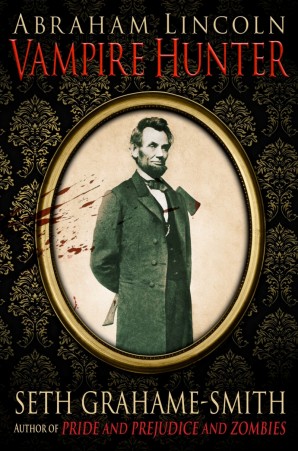
Review: ABRAHAM LINCOLN: VAMPIRE HUNTER, Seth Graham-Smith

When I first come across this novel as I hunted around the sales tables at Waterstones, the thing that struck me was how ridiculous the notion of the President of the United States during the Civil War, who was assassinated by a die-hard Confederate and actor, John Wilkes Booth, was a sort of Buffy vampire killer. I   knew that it couldn't be a serious piece of work. Indeed, the writer Seth Graham-Smith has also published other odd titles that people who frequent books shops will doubtless recognise: Pride and Prejudice and Zombies. The parody novel of Jane Austen's classic surpassed all expectations and became a surprise bestseller.

Yet if I have one major issue with this novel it is the question of whether I was supposed to take it seriously or as a joke. Considering the author's track record, the first assumption must be that it is a parody. The reason why it is so easy to be thrown one way or the other is because that the manner in which Graham-Smith presents this novel is very subtle. Posing it as an historical analysis of Abraham Lincoln's lost diaries, this is used to present the ridiculous story. Accompanied with mocked up photographs of Lincoln, posing with his "famed" ax with which he slayed the vampires, the book is not only written like a historian but has the feel of one also.

The problem isn't this but the fact that at times the author seems to find it hard to maintain the aura of a historian, and instead falls into the trap of simply talking through AL's diary entries rather than just 'picking out' sections and then summarising them in his own words. Moreover the manner in which the 'writer' comes across the 'lost diaries' is a rather cliche manner of a mysterious man passing them over. While this cover story only takes up about the first 20-pages, it still takes a long time to actually get into the book or become the amusing story that Vanity Fair boasts it to be.

Another issue I had was with the pace - it is often too quick, speeding through Lincoln's life like a runaway train. The depth of research that has gone into the novel is quite remarkable but at times it felt like reading a mixed cocktail of different types of writing: the diary, the historian and the novel writer. While this is not necessarily an issue when the three methods are employed effectively, I can't help but feel that more could have been done with this concept of Lincoln as a Vampire Hunter.

Overall this is undoubtedly a well-researched novel that has put a lot of attention into detail, especially in regards to the American Civil War. While the author's style of writing fails him now and then, this is a very easy novel to read and does not require much thinking about. It by no means keeps you wondering, not because it assumes the writer knows anything about Lincoln but because when the connection between vampires and the slave-owners of the American South is made, it feels too obvious a way to bring the book-sucking creatures into the Civil War environment. 

To people who might wish to avoid this novel because it is 'yet another vampire novel', they needn't fear as the vampire aspect at times does not really affect the overall presentations of Lincoln's life. The author finds a fair balance between portraying a human side to "Abe" as well as his eccentric vampire-hunter side, even if he doesn't quite manage to insert vampires comfortably into Lincoln's life. 

If I could say one thing about this book, it is that it is too short. I say this not because I enjoyed it so exceptionally that I wished I could read more, but because once I got to the end I felt it should have been longer. There is a lot that the author could have done and failed to do.

6/10

___

Want this book? Buy it here: